
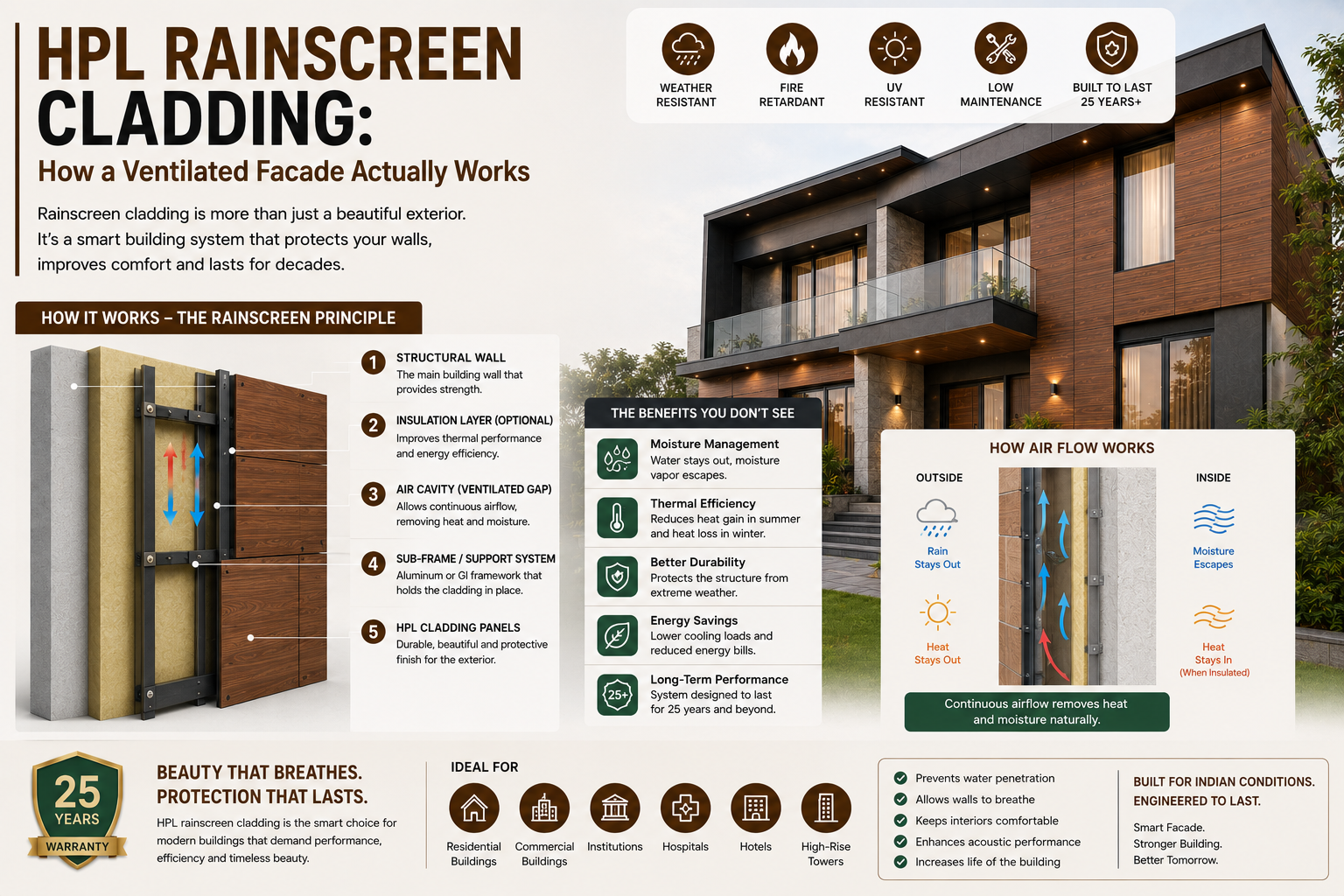
Quick answer: An HPL rainscreen is a facade where panels are fixed to a sub-frame with a continuous ventilated air gap behind them. The panel sheds most of the rain, the cavity drains and dries any water that gets past the joints, and moving air in the cavity carries away solar heat before it reaches the wall. It is the standard way exterior HPL is installed on serious projects.
Table of Contents
- The Principle: Two Lines of Defence, Not One
- Layers of an HPL Ventilated Facade
- Why the Cavity Matters So Much in India
- Open Joint or Closed Joint?
- Design Rules Worth Following
- Frequently Asked Questions
The Principle: Two Lines of Defence, Not One
A painted or plastered wall is a single-line system. Everything depends on that surface staying perfectly sealed, and it never does – hairline cracks, failed sealant and porous plaster eventually let water in, which is why Indian walls develop damp patches and peeling paint on the weather side.
A rainscreen splits the job. The HPL panel is the first line, taking wind-driven rain and sun. The cavity behind it is the second line, giving any water that passes through an open joint somewhere to run down and out, and giving the wall a chance to dry. Nothing depends on a perfect seal.
Layers of an HPL Ventilated Facade
| Layer | Function | Typical detail |
|---|---|---|
| Structural wall | Carries load | RCC, block work or brick |
| Insulation (optional) | Reduces heat transfer | Fixed to the wall face, non-combustible on tall buildings |
| Air cavity | Drains water, vents heat | Typically 25-50mm continuous, open at bottom and top |
| Sub-frame | Holds panels, transfers wind load | Aluminium brackets with vertical and horizontal members |
| HPL panel | Weather skin and appearance | 6mm or 8mm exterior grade, open or closed joint |
| Cavity barriers | Interrupt vertical fire path | At floor lines and around openings on tall buildings |
Why the Cavity Matters So Much in India
In a hot climate the cavity does more work than the panel. Solar radiation heats the outer panel, the air behind it warms, becomes buoyant and rises, and is replaced by cooler air drawn in at the base. This chimney effect continuously removes heat that would otherwise conduct into the wall.
The practical results on Indian buildings are consistent and easy to observe:
- Noticeably lower internal wall surface temperature on west elevations in the late afternoon.
- Reduced air-conditioning run time in rooms behind clad walls.
- Dry walls through the monsoon, because water that enters a joint drains rather than soaking into plaster.
- No repainting cycle, because the weather skin is a laminate rather than a coating.
- Existing surface defects are covered without demolition, which matters on renovation projects.
Open Joint or Closed Joint?
Open joint
Panels are spaced with a visible gap, typically 8-10mm, with a dark backing membrane so the cavity reads as a shadow line. This is the most common approach for HPL. It handles thermal movement freely, drains superbly, and gives the crisp modern grid most architects are after.
Closed joint
Panels butt closer with a gasket or profile between them. It gives a more monolithic appearance but demands tighter tolerances and puts more responsibility on the joint detail. It is used where the design language calls for a continuous surface.
In both cases, the cavity behind must remain open and ventilated. A rainscreen with the base sealed shut is just an expensive wall with a trapped humid gap behind it.
Design Rules Worth Following
- Keep the cavity continuous and open at the bottom and top of each ventilated zone.
- Use insect mesh at openings, not solid closers.
- Allow the panel to move – slotted fixing holes and a fixed point per panel.
- Design the joint width for the largest panel dimension, since movement scales with size.
- Detail window and door reveals early, because that is where most site improvisation happens.
- Keep the sub-frame in aluminium or treated steel, never untreated MS, especially in coastal cities.
Key Takeaways
- A rainscreen uses the panel as a weather screen and the cavity as a drainage and drying path.
- The ventilated cavity reduces heat gain into the wall, which is a major benefit in Indian summers.
- Open joints of 8-10mm are the usual detail for HPL and handle thermal movement well.
- The cavity must stay open at top and bottom for the system to work.
- Panels must be free to move – slotted holes and a single fixed point per panel.
Frequently Asked Questions
What is a rainscreen facade?
A rainscreen is a cladding system where panels are mounted with a ventilated air gap behind them. The panel sheds most rain and sun, while the cavity drains any water that gets through the joints and lets the wall dry, so the system does not rely on a perfect seal.
Does HPL rainscreen cladding reduce heat inside a building?
Yes. The ventilated cavity carries away solar heat by convection before it reaches the structural wall, which typically lowers internal wall surface temperature on sun-facing elevations and reduces air-conditioning load.
What cavity depth is needed behind HPL?
A continuous cavity of roughly 25-50mm is typical, kept open at the base and head so air can move. The exact depth depends on the sub-frame design, insulation thickness and the facade engineer’s assessment.
Can a rainscreen be installed on an old building?
Yes, and renovation is one of its strongest use cases. The system covers cracked plaster, damp stains and mismatched surfaces without demolition, provided the wall can carry the bracket anchors.
Is an open joint facade waterproof?
The joint is deliberately open, but the assembly is designed so water entering the joint drains down the cavity and out at the base. Waterproofing responsibility sits with the wall and the drainage detailing, not with the joint.
Related Reading on HPL Maker
Talk to HPL Maker
HPL Maker is an Indian manufacturer of exterior-grade high pressure laminate with an industry-first live camera warranty of up to 25 years. Share your drawings or elevation photos and our team will suggest the right shade, thickness and fixing system for your project.
- Call / WhatsApp: +91 89824 90236
- Email: marketing@hplmaker.com
- Factory & Head Office: 124-126, Vrindavan Palace, Nipania Main Road, Vijay Nagar, Indore – 452010, Madhya Pradesh, India